The Hungarian mathematician Alfréd Rényi once said, "A mathematician is a machine for turning coffee into theorems." The same might be said about writers and books -- or plays.
London's first coffeehouse opened in 1652 and was an instant hit. With not much exaggeration, it's been said coffee fueled the Enlightenment. As one recent account of London coffeehouses on the website Public Domain Review notes,
"Remember -- until the mid-seventeenth century, most people in England were either slightly — or very -- drunk all of the time. Drink London’s fetid river water at your own peril; most people wisely favoured watered-down ale or beer (“small beer”). The arrival of coffee, then, triggered a dawn of sobriety that laid the foundations for truly spectacular economic growth in the decades that followed as people thought clearly for the first time. The stock exchange, insurance industry, and auctioneering: all burst into life in 17th-century coffeehouses — in Jonathan’s, Lloyd’s, and Garraway’s — spawning the credit, security, and markets that facilitated the dramatic expansion of Britain’s network of global trade in Asia, Africa and America."
In the spring of 1575, Oxford wrote back to Lord Burghley from Paris that in his travels from Venice and beyond he intended to "bestow two or three months to see Constantinope and some part of Greece." That plus the fact that King Henri III of France had given Oxford letters of introduction to the Sultan's court in Constantinople suggest it's at least possible that the man Elizabeth called her "Turk" did in fact visit Turkey.
For me, when I was researching and assembling "Shakespeare" by Another Name, Turkey became a bridge too far in piecing together the most likely itinerary for Oxford's Italian, Adriatic, Mediterranean (and Aegean and Black Sea??) travels. I just couldn't make it all fit, and Turkey just seemed too far out of the likely orbit.
But there it is. Oxford said he wanted to go. And he had letters of passage from the King of France to give him entry.
There the coffee certainly flowed like water. Er... well at least syrupy water. A Turkish proverb from the time said coffee is best served "black as hell, strong as death, sweet as love."
Given how much Italy Oxford brought back to England with him in 1576, I'm inclined to suspect -- given the absence of Turkey (and coffee!) in his life and works and in the "Shakespeare" canon as well -- he never quite made it to Sultan Murad III's court.
The age of "Shakespeare" was still some 50 years before the dawn of the age of coffee in England. Hamlet written with the benefit of caffeine: It's a curious thought experiment at least, though I suspect it will forever be only just that.
Showing posts with label Venice. Show all posts
Sunday, January 12, 2014
Monday, July 02, 2012
Write What You Know
Novelist Nathan Englander has a new piece out on the website BigThink, below, in which he argues that "Write what you know" actually means, essentially, "Write what you feel." And it sounds really freeing. If you want to write a play about Venice, then write a play about Venice!
Having just completed a book about round-the-world voyages of scientists and explorers from the 1760s, and having traveled to only a tiny fraction of the locations portrayed in the book, I feel compelled to agree with him.
Yet there's a crucial caveat that goes unuttered by Englander too. Consider "Shakespeare" vs. Ben Jonson. Now, for instance, Jonson sets Volpone in Venice, and Jonson never traveled there.
But as one Jonson scholar noted, "Romeo and Juliet is part of an Italian night [!]; Shylock would possibly be ill at ease away from the Rialto[!!]; but the scene of [Volpone] might as well have been laid in Madrid or Edinburgh for all the effect Venice has on the characters."
In other words, Volpone is a great play -- just not a great Venetian play.
"Shakespeare," on the other hand... well, the Jonson scholar above isn't just making idle chatter. SBAN and Richard Roe's Shakespeare's Guide to Italy are just two of a number of books over the years that concur with the Jonson scholar and make it clear how much personal experience of the author's own Italian travels went into R&J, Merchant of Venice, etc.
So I certainly agree with Englander that writers should of course feel free to venture far and wide in the places and historical timeframes they write about. But there's still no faking first-hand knowledge.
In that sense, pace Mr. Englander, "Write what you know" really requires no interpretation at all. Nothing more or less than... "Write what you know."
Saturday, December 10, 2011
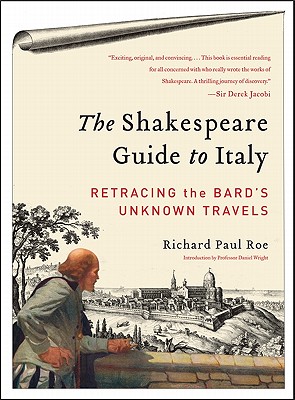
Guest post: How Did A Man Who Didn't Go to Italy Go to Italy? A review of Richard Paul Roe's The Shakespeare Guide to Italy
Book review of Richard Paul Roe, The Shakespeare Guide to Italy: Retracing the Bard's Unknown Travels (Harper Perennial, Nov. 2011)
by John Christian Plummer
Imagine that you lived in a time in which every educated person was absolutely certain that the planets Mars, Jupiter and Saturn moved both forward and backward. This is what the astronomer Tycho Brahe called “retrograde motion.” In Hamlet, when Claudius tells Prince Hamlet that a return to Wittenberg (the alma mater of Brahe) “is most retrograde to (the King’s) desire.”
From the standpoint of the 21st century, it requires a powerful feat of imagination to reckon that a vast celestial body like Mars would stop in the middle of space and reverse its direction. And that it would do so consistently. But that is precisely what many well educated 16th century Europeans thought happened, and they didn’t just make this up out of a desire for imaginative tales; they had a problem that needed explaining. The problem was Mars appeared at one point in the east of the sky, progressed westward, but then appeared back east of its westward position. If Mars were to move in that way as it orbited the earth…well…one logical explanation would suggest it wasn’t orbiting the earth. But that was impossible, of course, because Mars, Jupiter, Saturn and all the other planets, as well as the sun, absolutely did orbit the earth, because the earth, as everyone knew, was the center of the universe. So given that unassailable fact, Brahe proposed his theory of retrograde motion. Mars, like a crab, like Hamlet, moved backward.
From where we sit in the age of Einstein, it’s easy to chuckle at this absurd mental contortion which, we now know, flies in the face of not only the correct, heliocentric model of the solar system, but also basic Newtonian physics. But let us not forget that the educated Europeans of the 16th century were operating from a working hypothesis – the geocentric model of the universe – that was powerful enough to put mortal fears into the minds of men like Copernicus and Galileo, whose more elegant, thoroughly researched and ultimately accurate explanations eventually won the day.
It is no hyperbole to call Richard Paul Roe a twenty-first century Galileo of literature. Roe isn’t examining the stars without, but rather the stars within: specifically a third of the canon of the man some call the greatest author who ever set pen to paper, the man we call William Shakespeare. The so-called Italy plays of Shakespeare are the subject of Roe’s tremendous inquiry, and his more than two decades of painstaking investigation and research have resulted in the landmark book, The Shakespeare Guide to Italy, Retracing the Bard’s Unknown Travels, just released, posthumously, under the Harper/Perennial imprint.
Sunday, September 04, 2011
"Shakespeare" the Venetian: Why Titian matters
Following up on the previous post -- which finds Hamlet using dialect peculiar to East Anglia, where Edward de Vere grew up -- it's worth remembering that the Shakespeare canon is also brimming with evidence that the author knew and wrote about Italy from first-hand experience.
In a few cases, it's even possible to date when the author must have been there -- or, at least, communicated with someone who was in Italy at the time.
The Shakespeare epic poem Venus & Adonis provides one such clincher. It contains lines that suggest the author was in Venice -- and was capable of gaining entrée to a prestigious Venetian artist's studio -- sometime before August 1576, when the artist died.
Edward de Vere, Earl of Oxford, traveled in Italy using Venice as his home base from May 1575 through March 1576. When de Vere traveled to La Serenissima, the city of canals had one superstar celebrity who arguably eclipsed all other cultural figures in town: The painter Tiziano Vecellio, a.k.a. Titian (c. 1488/1490 - 26 Aug. 1576).
When the king of France, Henri III, had visited Venice in 1573, the king insisted on meeting Titian at the master's Venice studio. The octogenarian artist, former arch-rival of Michelangelo, had met and in many cases painted most of the leading intellectual, cultural, religious and political figures of the century.
An Italianate English lord -- an emissary from Queen Elizabeth's court -- visiting Venice would have almost been expected to pay homage to the city's greatest living cultural icon. To have neglected to do so could have verged on the impolitic.
If de Vere did indeed meet Titian, for starters, he could have heard a first-hand account of the life and the grisly death of one of Titian's patrons, the Duke of Urbino. The dearly departed Oxfordian scholar Andrew Hannas long advocated that Titian's portrait of Urbino, pictured here, was arguably the pictorial inspiration for King Hamlet's ghost, cap-a-pie, as Horatio says:
A figure like your father,
Armed at point exactly, cap-a-pie [head-to-toe],
Appears before them, and with solemn march
Goes slow and stately by them: ...
On the Elsinore battlements, we hear again about the ghost's armor, his pale complexion and his "countenance more in sorrow than in anger." Check, check and check. The apparition does, the soldiers say, have a grey beard. (Titian's Urbino doesn't.) Then again, aren't all ghosts supposed to look grizzled?
Anyway, Hamlet's play The Mousetrap stages Urbino's murder. Titian's patron was poisoned by a courtly rival named Gonzago. In the ear. (Hamlet says of the murderer, "His name's Gonzago: The story is extant, and writ in choice Italian.")
Titian could have told de Vere all about the gruesome deed his patron fell prey to and the insider politics behind Hamlet's play-within-a-play.
Titian also had in his studio at the time a masterpiece that would become a prime inspiration for the first work ever published under the name "Shakespeare," the 1593 epic poem Venus and Adonis.
Saturday, October 23, 2010
The Bard of Venice (VIDEO)
On September 23, 2011, Sony Pictures will be releasing a big-budget popcorn movie called Anonymous. As blogged on this page, the movie tells the tale of Edward de Vere as "Shakespeare" -- parts of which will be highly fictionalized, of course.
And so for the first time in history, a broad cross-section of the moviegoing public will be open to hearing out the factual story of Edward de Vere's epic life. And already primed for the many connections between his life and the Shakespeare plays and poems.
This is the (brief) opportunity that Nothing Is Truer Than Truth is poised to seize.
Filmmaker Cheryl Eagan-Donovan needs to raise $12,000 by December 1 to fund the final phase of her film -- shooting at the many Italian locations immortalized in the Shakespeare canon.
Please post this to your blog or facebook page. Please email your friends and English professors. Please tweet. (One possible suggested tweet is below.) And for those so inclined and enabled, please donate.
Thank you.
TWITTER-READY BLURB:
#Shakespeare lived in Venice and toured Italy. His Italian plays trace his travels precisely. http://kck.st/9DJB46 #PleaseRT
Saturday, March 29, 2008
Did Shakespeare visit Venice? ... Does the Pope wear Prada?

[Creative Commons image by Martino Pizzol]
The Times of London this week published an article that reconsiders the "cloak of invisibility" argument: Plays like Merchant of Venice are simply too replete with Venetian lore, geography, etc. that it forces the conclusion that the author must somehow have visited the city he so accurately immortalizes. So, given Will Shakspere as the author, he must have just slipped on his invisibility cloak for a year during those fabled Lost Years and snuck off across the Alps to make his way to La Serenissima -- all, of course, without leaving a single trace in the historical record. And these days, with his place of origin seeming more and more like Speculation-upon-Avon, why the hell not?
Shaul Bassi at the University of Venice recently co-wrote a book with the Italian writer Alberto Toso Fei titled Shakespeare in Venice (published in Italy, in Italian) that weighs in with what looks like not a small chunk of the same evidence "Shakespeare" By Another Name puts forward. Here's The Times:
It was striking that he had given the name “Gobbo” to Shylock's servant, a reference to the carved figure of a hunchback (Il Gobbo di Rialto) on the bridge, a feature well known in Venice but not beyond it. Shakespeare had also used local words such as gondola, as in Act 2, scene 8 of The Merchant, when Salarino remarks: “But there the duke was given to understand that in a gondola were seen together Lorenzo and his amorous Jessica.”
...Shakespeare knew about the Venetian custom of offering pigeons (“a dish of doves”) as a gift, and showed rare insight into cosmopolitan Venice's ethnic and social relations, and its tolerance of foreigners and minorities.
Bene bene! Eccezionale! Couldn't agree more. In fact, if you want to follow "Shakespeare" through Venice -- and the rest of Italy -- there's already a free Google Earth Atlas that let's you retrace his every step from the comfort of your own virtual desktop.
One hitch, though. A slight change of byline is needed.
But if the reader is willing to take that provisional step then, hey, the world is thine oyster.
Labels:
Earl of Oxford,
Edward de Vere,
Italy,
Shakespeare,
Venice
Subscribe to:
Posts (Atom)