Thursday, March 08, 2012

The FAQ - from this Oxfordian's POV

I recently received a questionnaire from some high school students doing a project on Edward de Vere, Shakespeare and the authorship question. They asked some good questions that really got to the heart of the matter in the Shakespeare debate.

A number of readers have requested I post the (14) questions and my responses to them. 

What follows are one Oxfordian's opinions and perspectives. Others in the trenches of course have very different opinions and points of view. Vive la diffĂ©rence. 

With that caveat in mind, then...

1. How long have you researched Shakespeare and the authorship question?

I have been researching Shakespeare and the authorship mystery since 1993. I wrote a book, published in 2005, "Shakespeare" by Another Name, which was republished in ebook format last year. 

SBAN presents what I -- along with a small but growing minority of scholars, writers, theatrical professionals and Shakespeare buffs -- suspect is a very likely scenario, namely that the Elizabethan court dramatist Edward de Vere, 17th Earl of Oxford, played a key role in the creation of the plays and poems published under the name "Shakespeare." I personally suspect de Vere was essentially the author himself. Others find a group collaboration scenario more probable. In any event, de Vere deserves much more attention by both scholars and people in the theater -- who of course bring these works to life. 

2. What ultimately made you believe Shakespeare was not the true author of all of his plays, sonnets, etc.?

Here's a great website that collects many of the so-called "anti-Stratfordian" arguments but does not advocate for any alternative "Shakespeare" candidate. Check out the YouTube video, in particular. A fine introduction to the case. 

Wednesday, February 08, 2012

Anonymous, the contest - win a free DVD/Blu-Ray

For the next 48 hours, Recently the "Shakespeare" by Another Name blog will be holding held a contest to win a free DVD or Blu-Ray disc of the movie Anonymous. To enter, just share the link to this blog post with your network on Facebook, Tumblr, Twitter, Google Plus, LinkedIn or your favorite social network of choice and email the link to feedback at shakespearebyanothernname dot com.

The contest ends at noon eastern US time on Friday (Feb. 10). Friday afternoon, then, the contest's winners will be notified. 

UPDATE: The contest's two winners have been notified. Congratulations to both! And thank you to all who entered the contest. See the Facebook page ShakesVere for more.

The first place winner received a free DVD or Blu-Ray copy of the newly released historical thriller Anonymous. (Winner's choice of DVD or Blu-Ray, whatever works for your home video setup.) 

Second place is a copy of Anonymous's companion book

So what is Anonymous? It's a fantastical historical rollercoaster ride based on the epic life and very Shakespearean times of Edward de Vere, Earl of Oxford. As Rex Reed wrote in the New York Observer
Shakespeare may be the most performed playwright in the history of letters, but in 400 years not one original script has been found in his own handwriting. When he died at 52, survived by an illiterate wife and daughter, he left behind in his will no mention of a single manuscript. In Anonymous, an obvious labor of love for director Roland Emmerich, the culprit is identified as Edward de Vere, the 17th Earl of Oxford, a wealthy aristocrat who could not attach his real name to works of lusty romance, tragedy and political intrigue because they lampooned prominent members of the court. ... I found it a complex cornucopia of ideas and panache. You go away sated.
Or as Morgan Freeman told USA Today, "Have you seen Anonymous? Oh, don't miss that one. Do. Not. Miss. Anonymous. Another well-made movie; very well-done."

Of course, Anonymous is also a glorious piece of Hollywood filmmaking -- which means it sometimes takes some liberties. This blog, while unreservedly recommending the movie, has chronicled a few

To really delve into de Vere's tremendous depth and epic, page-turning life  -- with its rich network of connections between de Vere's life and the "Shakespeare" works -- Edward de Vere's literary biography, "Shakespeare" by Another Name is the book to read. 

Just a few months ago "Shakespeare" by Another Name was released as an ebook, and less than the price of a movie ticket will open a whole new world of connections to the greatest plays ever written

In the words of some prominent journalists and reviewers, SBAN is a gripping and controversial alternative biography of the Bard that "deserves serious attention."[1] The book "makes a compelling argument,"[2] "quite a compelling argument"[3] that is "especially impressive."[4]

[1] The New York Times
[2] USA Today
[3] The Chicago Sun-Times
[4] The Atlanta Journal-Constitution

Saturday, December 10, 2011

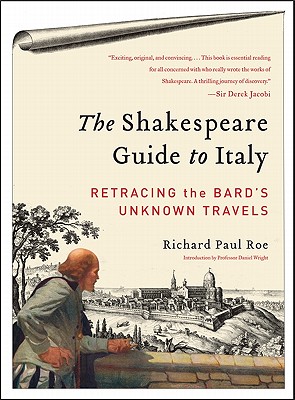
Guest post: How Did A Man Who Didn't Go to Italy Go to Italy? A review of Richard Paul Roe's The Shakespeare Guide to Italy

Book review of Richard Paul Roe, The Shakespeare Guide to Italy: Retracing the Bard's Unknown Travels (Harper Perennial, Nov. 2011)

by John Christian Plummer

Imagine that you lived in a time in which every educated person was absolutely certain that the planets Mars, Jupiter and Saturn moved both forward and backward.  This is what the astronomer Tycho Brahe called “retrograde motion.”  In Hamlet, when Claudius tells Prince Hamlet that a return to Wittenberg (the alma mater of Brahe) “is most retrograde to (the King’s) desire.” 

From the standpoint of the 21st century, it requires a powerful feat of imagination to reckon that a vast celestial body like Mars would stop in the middle of space and reverse its direction.  And that it would do so consistently.  But that is precisely what many well educated 16th century Europeans thought happened, and they didn’t just make this up out of a desire for imaginative tales; they had a problem that needed explaining.  The problem was Mars appeared at one point in the east of the sky, progressed westward, but then appeared back east of its westward position.  If Mars were to move in that way as it orbited the earth…well…one logical explanation would suggest it wasn’t orbiting the earth.  But that was impossible, of course, because Mars, Jupiter, Saturn and all the other planets, as well as the sun, absolutely did orbit the earth, because the earth, as everyone knew, was the center of the universe.  So given that unassailable fact, Brahe proposed his theory of retrograde motion. Mars, like a crab, like Hamlet, moved backward.
           
From where we sit in the age of Einstein, it’s easy to chuckle at this absurd mental contortion which, we now know, flies in the face of not only the correct, heliocentric model of the solar system, but also basic Newtonian physics.  But let us not forget that the educated Europeans of the 16th century were operating from a working hypothesis – the geocentric model of the universe – that was powerful enough to put mortal fears into the minds of men like Copernicus and Galileo, whose more elegant, thoroughly researched and ultimately accurate explanations eventually won the day.

It is no hyperbole to call Richard Paul Roe a twenty-first century Galileo of literature.  Roe isn’t examining the stars without, but rather the stars within: specifically a third of the canon of the man some call the greatest author who ever set pen to paper, the man we call William Shakespeare.  The so-called Italy plays of Shakespeare are the subject of Roe’s tremendous inquiry, and his more than two decades of painstaking investigation and research have resulted in the landmark book, The Shakespeare Guide to Italy, Retracing the Bard’s Unknown Travels, just released, posthumously, under the Harper/Perennial imprint.

Wednesday, November 23, 2011

"Anonymous" with a Byline - Screenwriter John Orloff interview (part 2)

As of the writing of this blog post, the Oxfordian biopic Anonymous has earned $6.9 million in international box office revenue. The movie also continues to open in staggered release in countries all over the world through the end of February. Later in 2012, of course, its extended life will begin on home video, on television, on airplane flights, in classrooms, etc. 

Despite the sometimes astonishingly vein-bulging tantrums of Oxfordian deniers, Anonymous will continue to introduce millions of people to the Shakespeare authorship mystery and to the most likely alternative "Shakespeare" candidate -- Edward de Vere, Earl of Oxford. 

We're grateful for Anonymous screenwriter John Orloff giving this blog an exclusive long-form interview with him about the alpha to omega of his script. (Orloff has also generously provided some of his own personal collection of photographs he took while on set with director Roland Emmerich -- during the movie's principal photography last year.) 

In part one of the "Shakespeare" by Another Name Blog's interview with Orloff, we discussed the screenwriter's own discovery of the Shakespeare authorship question courtesy of the 1989 PBS Frontline documentary The Shakespeare Mystery. Orloff ultimately wrote a screenplay about Edward de Vere and "Shakespeare," a script he originally titled Soul of the Age

Orloff had, he said, shopped it around Hollywood. And on the strength of Soul of the Age, Orloff had had meetings with Tom Hanks -- who ultimately hired Orloff to write two scripts for Hanks' co-production with Steven Spielberg, Band of Brothers

(SPOILER ALERT: This part of the interview with Orloff (part 2 of 3) begins getting into the thick of the movie's plot.)

MARK ANDERSON: Does Tom Hanks have an opinion on the authorship question?

JOHN ORLOFF: We never discussed it. My guess is he's a Stratfordian. But we never got deep into it. But Soul of the Age led to me getting a writing career and doing other work. A lot for Tom. 

MKA: Beyond Band of Brothers?

JO: Only that was produced. But I wrote about three more scripts for Tom over the years. And then meanwhile, I got a phone call from my agent saying Roland Emmerich is looking for writers for this disaster movie he's going to make about global warming. I said, "I don't know if I'm the right guy for that kind of stuff. I don't know the genre that well."

But [my agent] said, 'Yeah, but he's heard a lot about you. He really wants to meet you.' 

MKA: So this was when?

JO: This was 2002 or '03. We sat down in his office, and we talked about "Day After Tomorrow." Which sounded totally cool. But it also sounded like a movie I didn't understand as a writer. It's very outside of my wheelhouse, as they say. 

The other thing is, as a writer, I have to write things I love. And I don't know that genre as well as I should. And I said that to Roland. I said, "I'm so flattered that you think I can do this. I'm not sure I can. And I think quite frankly you can get a lot of writers who are way better than me for this kind of material." 

He said, "Well, what else have you written?" And I do what I always do, which is, I say, "Funny you should ask. Do you know anything about the Shakespeare authorship issue." And as usual there's a blank face. And I start doing my spiel, my 20 minute spiel. And I could see he was really interested. He said he wanted to read it. And about a week or two later, my agent called me up and said, "Hold on to your seat. Roland Emmerich wants to buy your script."

Which was a surprise. As it would be to anybody. Now that I know Roland, it's not a surprise at all. But not knowing Roland it seems like a surprise. 

Sunday, November 13, 2011

"Shakespeare" with an E - The new 2011 ebook edition of "Shakespeare" By Another Name

As noted previously on this blog, on the ShakesVere Facebook boards and elsewhere, "Shakespeare" by Another Name has been updated and revised for an ebook edition

Today, I'm pleased to announce, the ebook of SBAN is now online and available for sale at ebook retailers across the Internet and around the world. The new ebook copy is also now being converted into a print-on-demand paperback that will be available for sale later this year. More announcements on that front forthcoming. 

Anyone with an ebook reader, smartphone, tablet or even just plain old PC or laptop can buy the ebook and read it on their device(s). The ebook is available in formats for all the major portable reader devices today (Kindle, Nook, iPad, iPhone, iPod Touch, Android tablets & smartphones, Google Books devices, etc.). Formats for reading the ebook on your PC/laptop reader (PDF) are also available or will soon be available, depending on the outlet. (Some sites take longer than others.) 

The central clearinghouse for all of this is the publisher's page for SBAN. As of this writing, SBAN's ebook publisher, Untreed Reads, is offering a 30% off sale -- just $5.59 for "Shakespeare" by Another Name in its new e-formats. 

Friday, November 11, 2011

"Anonymous" with a Byline - Screenwriter John Orloff interview (part 1)

Note: A year ago, the screenwriter John Orloff sent an email over the transom and started what has become a yearlong correspondence about his Edward de Vere biopic Anonymous (with which "Shakespeare" by Another Name is unaffiliated -- although that said, I very much enjoyed the film and hope everyone reading these words takes the opportunity to see this tremendous movie on the big screen).

When the publicity push for Anonymous was kicking into high gear, in early October, Orloff sat down for an interview for the "Shakespeare" by Another Name Blog at Orloff's office in western Massachusetts.

Orloff had already, three weeks before the movie's release, heard and read so much misrepresentation of what his movie was about and where it was coming from. In this long-form interview, Orloff wanted to help set the record straight. He also, very kindly, provided a number of his own behind-the-scenes photographs from the set of Anonymous, some of which are below.

What follows is the first part of the transcript (part 1 of 3) of our two-hour interview.


MARK ANDERSON: So let's start at the beginning. You're coming out of UCLA film school and eager to get into the film and TV industry. What happens next?

JOHN ORLOFF: What happened was 20-some-odd years ago, it was a very different film business. And it was a lot harder to get in to. Especially as a screenwriter. I first realized that I didn't have anything to write. I hadn't lived. I had nothing to say. And I was 22 years old. I had a relatively sheltered life. I lived in LA all my life. I'm actually fourth-generation film business. My great-grandparents were Fibber McGee and Molly. Jim Jordan and Marian Jordan. Their son, Jim Jordan Jr. was a TV director, and my grandmother was a B-movie actress. My father was a commercial director. And my brother's an Academy Award winning sound mixer.

In my 20s, I ended up working in advertising, because I could get work there. Just struggling to figure out what I wanted to do with my life. And then I met my now-wife, who at the time was working at HBO in the long-form movie division. She would bring home these long form scripts that tended to be non-fiction based. Movies about Dorothy Dandridge, the African American Baseball League. I've always been interested in non-fiction based movies. A lot of my favorite movies are David Lean movies. I love historical films.

One thing led to another, and I started talking to my wife about the Shakespeare authorship issue, which I'd already learned about through the "Frontline" [episode on the Shakespeare Debate]. This was probably 1995. But I'd learned about the issue around 1989. Which led me to then going, "This seems true. It seems crazy that I've never heard of this." That led me to reading Ogburn's book as my first book. I was really just blown away by it. As many people are.

Tuesday, October 25, 2011

Comment-upon-comment: The scholars consider

On the Facebook ShakesVere boards, Geoffrey Green points to a recent blog post by a Stratfordian  scholar who sighs and says, OK, Anonymous now means we have to take on the Oxfordians. 

My comment on this literary scholar's blog after the jump.